I Fell for Coffee in 2021. Then I Went Down the Rabbit Hole.
Where coffee is actually grown, who gets paid, why your cup got so expensive in 2025, and how to keep it a drink instead of a dessert. An obsessive's field guide to the bean.
00 · The confession: it started with a moka pot and a worse habit
In 2021 I bought an Italian moka pot and a hand grinder for the beans, mostly to survive a stretch of long, indistinguishable days. Within a month it had stopped being a tool and become a ritual; within a year the ritual had quietly become a dependency I could measure in headaches on the mornings I skipped it. I was, by any honest definition, hooked.
What saved the habit from being purely a vice was a small, nagging question: what is this stuff, actually? I could tell you the difference between a good cup and a bitter one, but I had no idea where the beans came from, who grew them, what they were paid, or why the same drink could be medicine in one cup and dessert in the next. So I did what I do with everything: I pulled the thread. This is what came off the spool.
01 · Origin: your coffee grew in a thin green ring around the planet
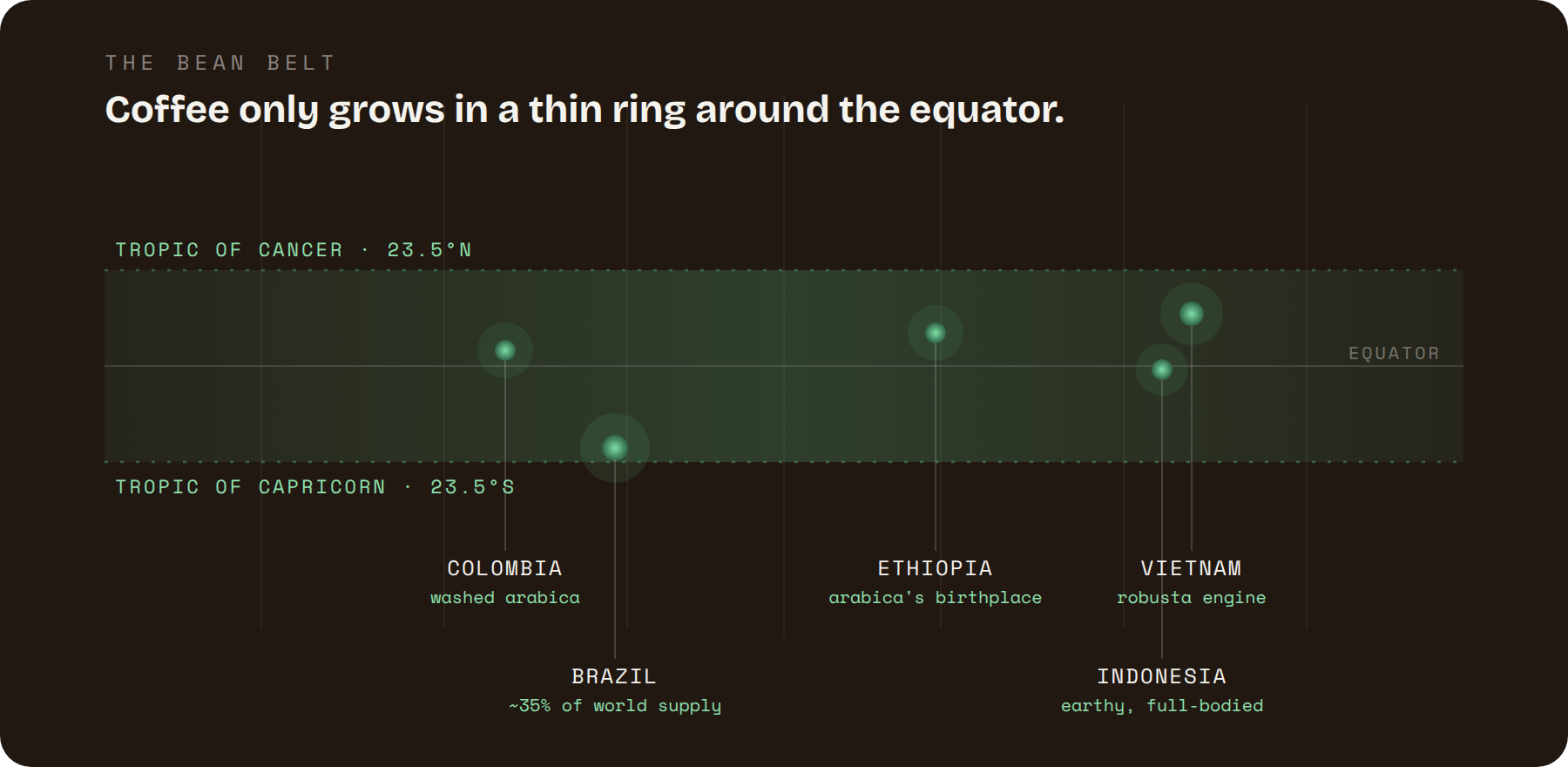
Coffee is fussy about where it lives. It wants altitude, steady warmth, reliable rain, and no frost, a combination you only find in a band roughly between the Tropic of Cancer and the Tropic of Capricorn. Growers call it the Bean Belt, and effectively every bean you’ve ever tasted came from inside it.
Two species do almost all the work. Arabica, about 60% of world supply, grows higher and slower, tastes sweeter and more complex, and is famously delicate about temperature. Robusta, most of the rest, is hardier, carries more caffeine, tastes blunter, and is the backbone of instant coffee and a lot of espresso blends. When people argue about coffee quality, they’re usually arguing, without knowing it, about these two plants.
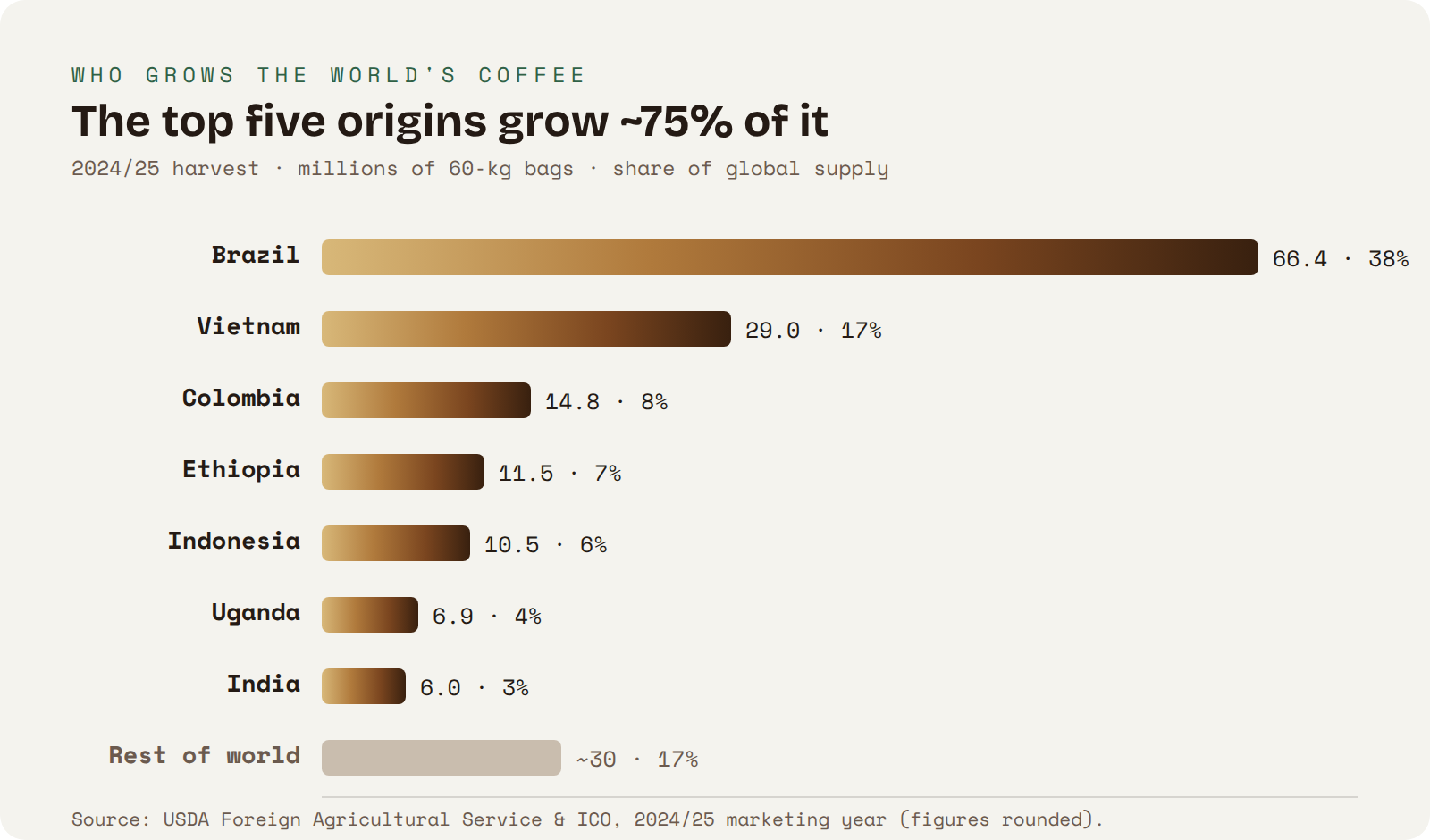
The striking thing isn’t the ranking. It’s the concentration. Brazil alone grows roughly a third of the planet’s coffee; the top five origins grow about three-quarters of it. That’s efficient right up until the weather turns, at which point a bad season in two countries can move the price of every cup on Earth. Hold that thought; it becomes the whole story in a few sections.
02 · The journey: cherry to cup is a dozen hands and three continents
Here’s the fact that reorganized how I think about the drink: coffee is a fruit. The bean is the seed of a small red cherry, and getting that seed from a hillside in Ethiopia into your kitchen is a genuinely long relay. Someone picks the ripe cherries, usually by hand. Someone processes them, washed, natural, or honey, each producing a different cup. They’re dried, hulled, graded, and sorted. Then they’re exported as raw green beans, shipped across an ocean, imported, roasted (almost always in the consuming country, which is where most of the markup lives), ground, and finally brewed by you.
Every one of those steps adds cost and takes a cut. And when you follow the money instead of the beans, the chain runs in reverse of your sympathy.
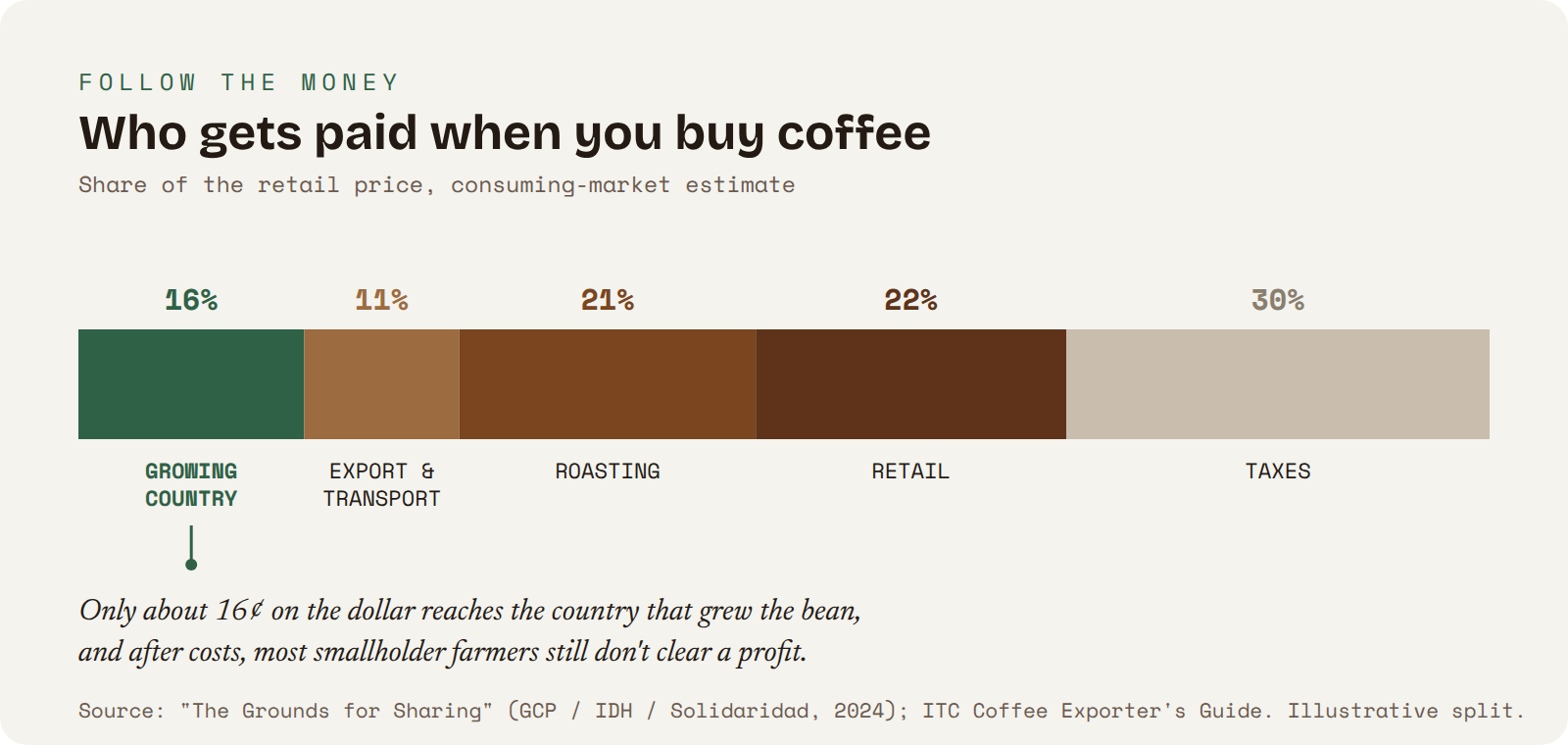
Of what you hand over at the counter, only around 16¢ on the dollar makes it back to the country that actually grew the bean, and after a farmer’s own costs, the majority of smallholders don’t clear a profit on even that. The older rule of thumb was that growers keep about 10% of the retail price; a detailed 2024 study traced the split more precisely and reached a more uncomfortable conclusion: the numbers are complicated, but the outcome isn’t. The value pools downstream, in roasting, retail, and taxes in wealthy consuming countries, for structural reasons with roots that go back to the colonial trade.
Fair-trade and direct-trade labels help at the edges. None of them have actually rebuilt a chain that was designed, centuries ago, to concentrate the money at the drinking end.
The practical takeaway isn’t guilt, it’s attention. Buying from roasters who publish what they pay at origin does more than a certification logo, and “just pay more for coffee” turns out to be too simple a fix on its own, because paying more doesn’t help if the extra never reaches the farm.
03 · The spike: then, in 2025, the bottom line bit back
If your coffee got noticeably pricier, you weren’t imagining it. In early 2025 arabica futures hit roughly $4.30 a pound and the industry’s benchmark index touched its highest level in about 47 years, territory it hadn’t seen since the great frost of the late 1970s.
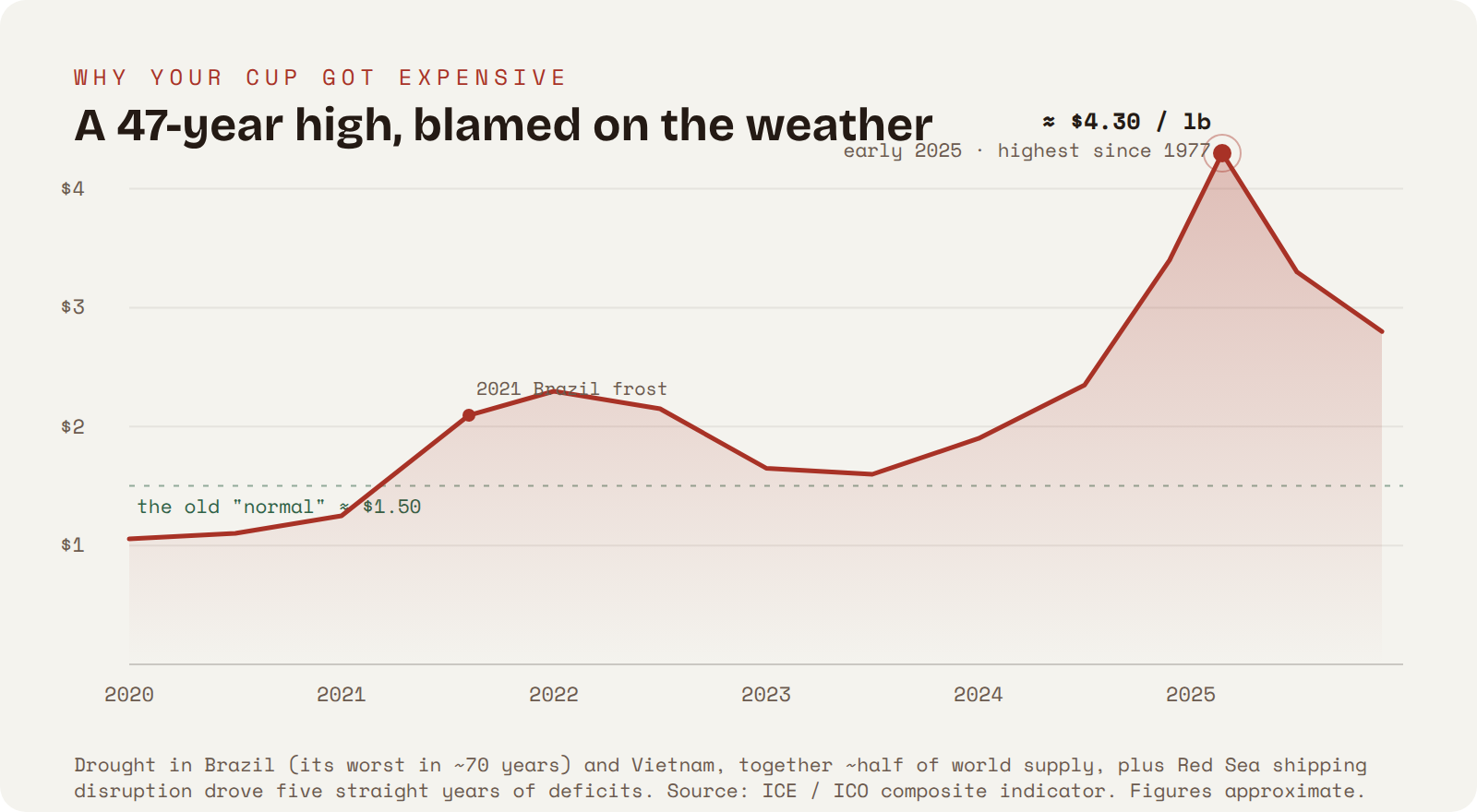
Remember that concentration problem? This was it, cashing in. Brazil endured its worst drought in about seventy years alongside tens of thousands of wildfires across coffee country; Vietnam, the robusta engine, got hit by drought and lost roughly a fifth of a crop. Those two countries are about half the world’s supply. Add snarled Red Sea shipping and a round of tariff drama, and you get five consecutive years of supply deficits stacking on top of each other.
Prices eased through late 2025 as better harvests came in, but they settled at a distinctly higher floor than the 2010s. And here’s the part that connects back to the last section: even a historic price spike doesn’t reliably reach the farmer. Arabica’s narrow tolerance for heat makes it the canary in the climate coal mine, which means the volatility is structural, not a one-off. The cheap cup may simply be over.
04 · The chains: what the big chains got right, and what they cost us
It’s fashionable among coffee obsessives to sneer at the big chains, and I did too, until I tried to be fair about it. The honest verdict is split.
The case for them
- They made a reliable, decent-enough cup available almost anywhere, which is genuinely useful.
- They handed the mainstream a vocabulary (espresso, single-origin, the idea that beans have a provenance) that specialty cafés later inherited.
- Their scale can fund sourcing and sustainability programs, and premiums, that a small roaster simply can’t.
- For a lot of people, the chain café is a real third place: neither home nor work.
The case against
- Homogenization: every high street starts to taste the same, and independent cafés get squeezed.
- They trained a generation to expect “coffee” to taste like sugar and milk, the dessert-ification we’re about to quantify.
- The menu is engineered around the industry’s “bliss point,” the sugar-fat-salt ratio built to keep you ordering.
- Convenience anchors expectations: fast and sweet becomes the default, and the actual bean becomes an afterthought.
My settled take: the chains are a gateway, not a destination. They democratized access to coffee and, in the same motion, flattened its ceiling. Both things are true.
05 · The dessert problem: most “coffee drinks” are milkshakes wearing a coffee costume
This is the section that changed my ordering. We’ve collectively decided that a tower of blended sugar counts as coffee because it has the word next to it on a menu. The numbers disagree.
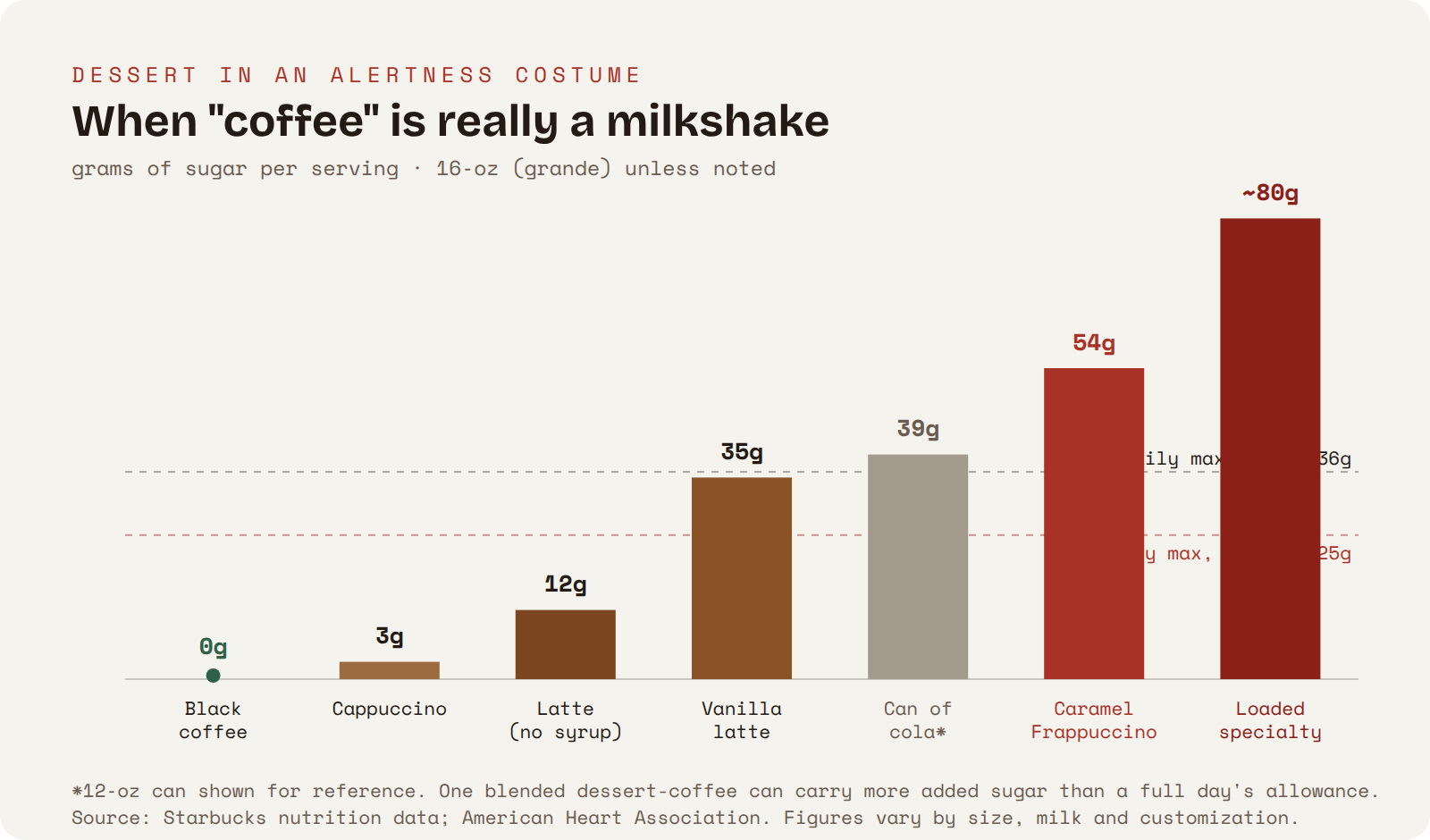
A grande caramel Frappuccino carries around 54 grams of sugar; the loaded, seasonal, whipped-cream-crowned versions can push toward 80. For comparison, a can of cola has about 39. The American Heart Association’s entire daily added-sugar allowance is 25 grams for women and 36 for men, so a single blended “coffee” can blow past a full day in one cup.
And the cruelest detail: a Frappuccino delivers only around 90 mg of caffeine, less than a plain brewed cup. You’re paying, in sugar and calories, for dessert, while getting less of the one functional thing coffee is for. None of this means never. It means calling the drink what it is: a treat, an occasional one, not a daily fuel you’ve mislabeled as coffee.
06 · The upside: black coffee is one of the best-studied healthy habits we have
Here’s the reward for reading this far, and the reason I didn’t quit: taken black, coffee is remarkably good for you, and the evidence base is enormous rather than fringe.
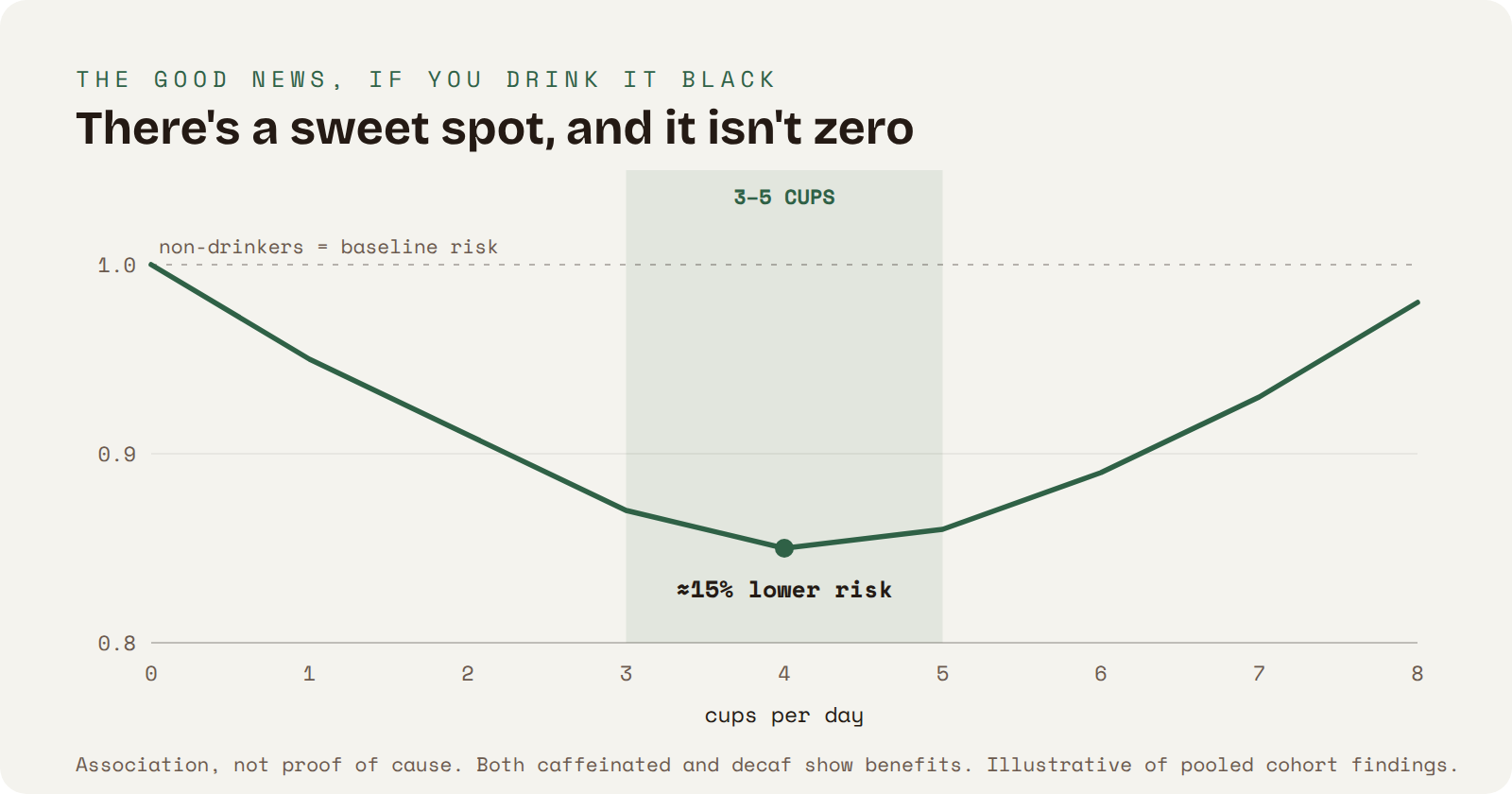
Across large population studies, moderate drinkers, roughly three to five cups a day, show lower all-cause mortality than non-drinkers, on the order of a 15% reduction, along with lower risks of cardiovascular disease, type 2 diabetes, stroke, and cognitive decline. Coffee is especially kind to the liver: its chlorogenic acids and caffeine are linked to lower rates of fatty liver, cirrhosis, and liver cancer, to the point that liver specialists sometimes recommend a few cups a day to patients.
Two caveats keep this honest. First, this is association, not proof; coffee drinkers differ from non-drinkers in other ways too. Second, and crucially, notice that decaf shows many of the same benefits, which tells you the good stuff isn’t only the caffeine. It’s the plant compounds. All of which lands on one unglamorous instruction: the upside lives in the coffee, not in what you stir into it. Drown it in syrup and you measurably erase the advantage.
07 · The fine print: how to enjoy it without it enjoying you
Coffee’s benefits sit inside a dose. Cross it and the same drug that sharpens you starts working against you. A short field manual:
- Cap caffeine around 400 mg a day. That’s roughly three to five cups; one brewed cup runs 100–200 mg. Above that, the returns turn negative.
- Pregnancy is a different limit. Guidance is to stay under about 200 mg of caffeine a day, worth confirming with a doctor.
- Mind the clock. Caffeine has a half-life of about five to six hours, so a mid-afternoon cup can still be in your bloodstream at bedtime. Some people are genetically slow metabolizers and feel it far longer.
- Watch the tells. Jitters, a racing heart, anxiety, acid reflux, and the classic withdrawal headache all mean you’ve found your ceiling.
- Blame the add-ins first. Nine times out of ten it isn’t the coffee that’s the problem; it’s the sugar and cream riding along with it.
08 · Where I landed: what changed after I learned all this
I still drink coffee every day. The difference is that I now drink it black, or close to it, so the sugar never cancels the point. I buy from roasters who’ll tell me what they paid at origin, because I’ve seen where the money doesn’t go. I treat the blended dessert-drinks as exactly that, just dessert, and I’ve made a strange kind of peace with the fact that the cheap cup is probably a thing of the past.
Mostly, though, learning how coffee works didn’t make it less magical. A fussy little fruit grows in a thin ring around the equator, passes through a dozen hands and an ocean, and ends up warm in my kitchen for the price of pocket change. Knowing all of that, it tastes better, not worse.
A note on the health claims
Every health and nutrition figure in this piece, meaning the mortality numbers, the disease-risk reductions, the liver findings, and the caffeine and sugar limits, comes from population-level studies and general public-health guidance, not from individual medical advice. Associations found across large groups do not predict what coffee will do for any one person, and individual tolerance varies widely. None of it is a substitute for talking to a doctor or a registered dietitian, especially if you are pregnant, take medication, or have a heart, liver, sleep, or anxiety condition.
Sources & further reading
International Coffee Organization (global prices & consumption) · USDA Foreign Agricultural Service (production estimates) · UN FAO (market trends) · The Grounds for Sharing, GCP / IDH / Solidaridad, 2024 (value distribution) · ITC Coffee Exporter’s Guide (farmer price share) · Mayo Clinic & Cleveland Clinic (coffee & health) · U.S. FDA (caffeine guidance, ~400 mg/day) · American Heart Association (added-sugar limits).
Production and price figures are rounded and reflect the 2024/25–2025/26 seasons; health findings describe associations from pooled studies, not medical advice. If caffeine, sleep, or anything you eat or drink is becoming a source of real distress, a doctor is the right person to talk to.
Have thoughts on this? I'd genuinely love to hear them. Find me on X or LinkedIn.
A note: The views here are my own and don't represent my employer or anyone I work with. Everything I write is personal opinion, shared for general informational and educational purposes, and reflects my thinking at the time of writing. It is not professional, financial, legal, or investment advice. Please read posts in full rather than pulling lines out of context, and do your own research before acting on anything.