Blockchain, Without the Hype: A Plain-English Guide
What a blockchain actually is, how it works, and where it's genuinely useful, explained with one running analogy and six diagrams.
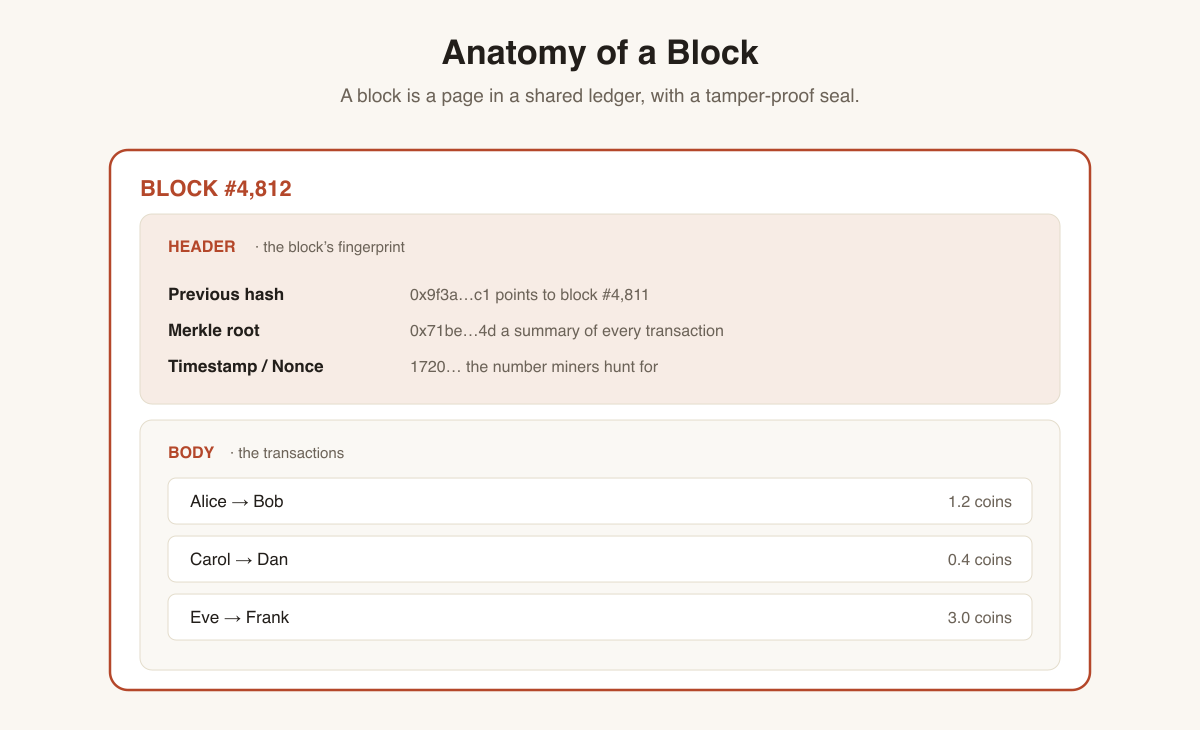
Most explanations of blockchain start with a wall of jargon (distributed, immutable, trustless, cryptographic) and hope you nod along. Let’s do the opposite. Here is the whole idea in one sentence:
A blockchain is a shared notebook that everyone can copy, no one can secretly edit, and no single person is in charge of.
That’s it. Everything else (the mining, the hashes, the consensus, the coins) exists to defend those three properties. If you keep the notebook in mind, the rest stops being mysterious. Let’s build it up piece by piece.
1. What a Blockchain Actually Is
Imagine a notebook that records who paid whom. Ordinarily, a notebook like this lives in one place (a bank’s database, a company’s server) and one organization decides what goes in it. A blockchain flips that: thousands of people each keep an identical copy of the notebook, and they follow a shared set of rules for adding new pages.
A few properties fall out of that setup:
- It’s append-only. You can add a new page, but you can’t rip one out or scribble over an old one without everyone noticing.
- It’s ordered. Pages are numbered and linked, so the sequence of events is unambiguous.
- It’s replicated. Because everyone holds a copy, there’s no single computer whose failure or corruption takes the whole thing down.
The “block” is a page. The “chain” is the fact that each page is cryptographically tied to the one before it. As the diagram above shows, a single block has two parts: a header (its fingerprint and a pointer to the previous block) and a body (the actual transactions).
The magic ingredient in the header is the hash: think of it as a fingerprint for data. Feed any content into a hash function and you get a short, fixed-length string back. Change even a single character of the input and the fingerprint changes completely and unpredictably. That property is what makes the notebook tamper-evident, which brings us to how it all links together.
2. How It Works
Blocks that vouch for each other
Every block’s header contains the hash of the previous block. So block #4,812 literally carries a fingerprint of block #4,811, which carries a fingerprint of #4,810, all the way back to the very first “genesis” block.
This chaining is why you can’t quietly rewrite history. If a bad actor edits a transaction in an old block, that block’s fingerprint changes, which means the “previous hash” stored in the next block no longer matches. That mismatch cascades forward, breaking every seal down the line.
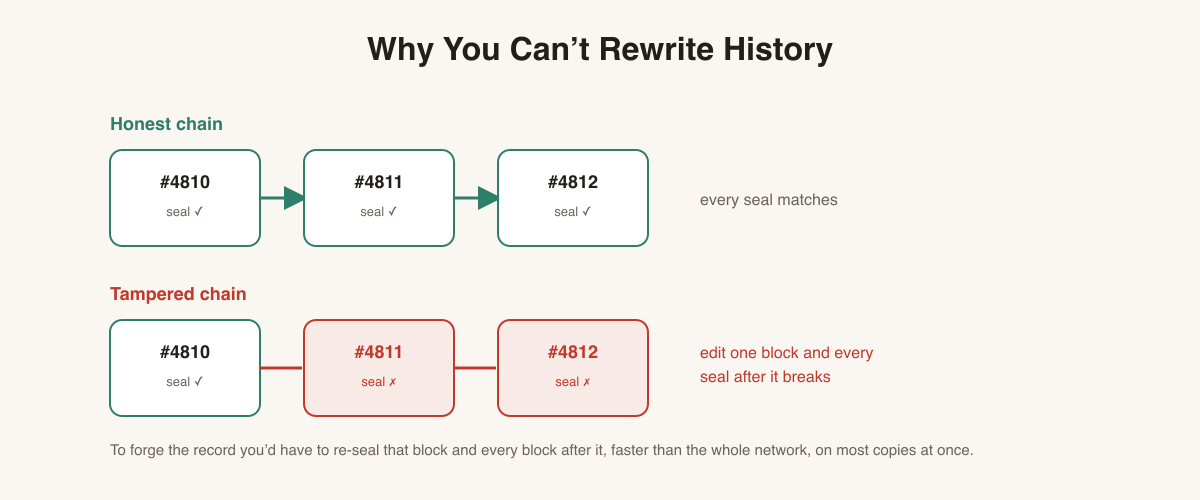 Edit one page and its fingerprint changes, so the next page’s back-pointer no longer matches. The break is instantly visible to everyone.
To successfully forge the record, you wouldn’t just re-seal one page. You’d have to re-seal that page and every page after it, faster than the rest of the network is adding new ones, on a majority of the world’s copies simultaneously. That’s the wall attackers keep running into.
How a transaction actually travels
So how does a payment get from “send” to permanently recorded? It moves through a short pipeline.
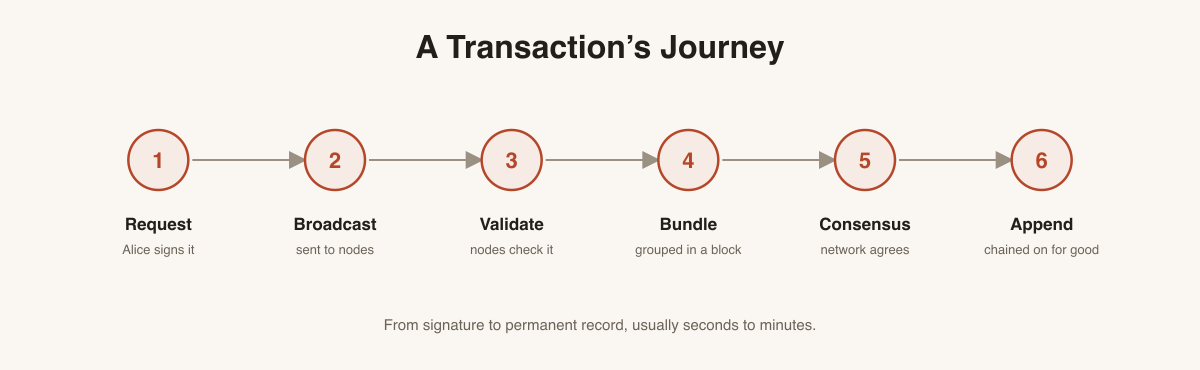 A transaction’s journey from signature to permanent record, usually seconds to minutes depending on the network.
- Request. Alice signs a transaction with her private key, a secret only she holds. The signature proves it’s really her without revealing the key.
- Broadcast. The signed transaction is gossiped out to nodes across the network.
- Validate. Each node independently checks it: is the signature genuine? Does Alice actually have the funds? Does it follow the rules?
- Bundle. Valid transactions get grouped into a candidate block.
- Consensus. The network agrees this block is legitimate (more on this next).
- Append. The block is chained on. The record is now practically permanent, and it will be reconfirmed by every future block built on top of it.
Consensus: agreeing without a boss
Step 5 is the clever part. With no central authority, how do thousands of strangers agree on which block comes next, and trust that no one is gaming the system? This is the consensus mechanism, and two recipes dominate.
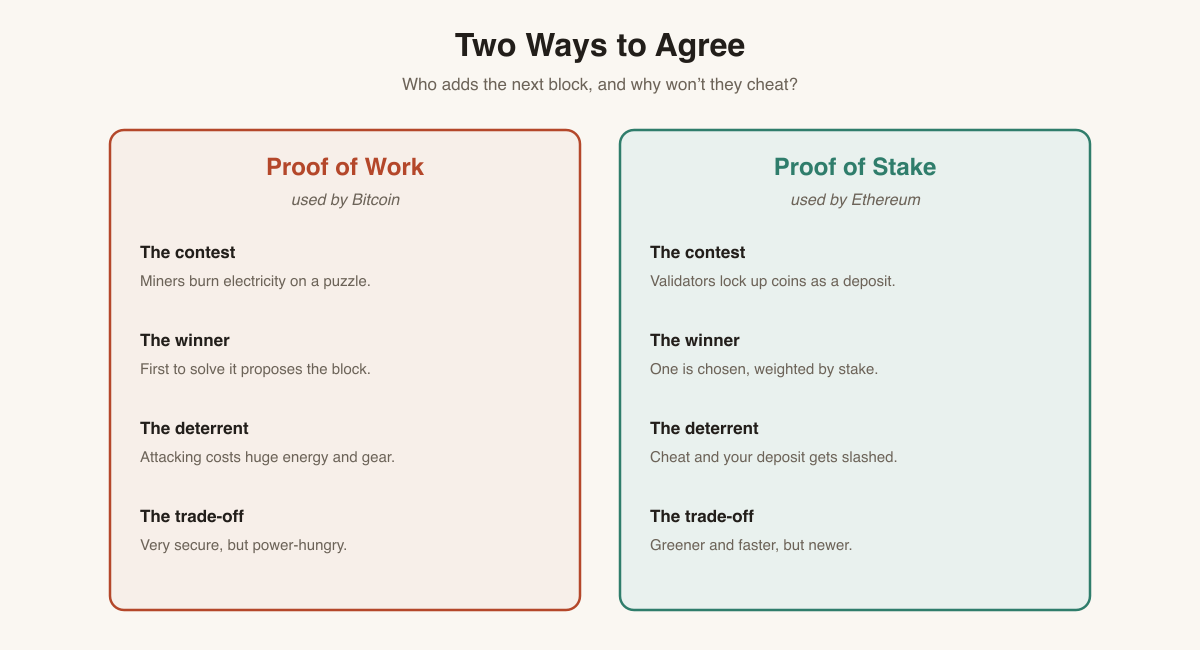 Two ways to answer “who adds the next block, and why won’t they cheat?”
Proof of Work (Bitcoin) turns block-creation into a costly puzzle. Miners burn real electricity racing to find a special number; the winner proposes the next block and earns a reward. Cheating is deterred because attacking the network would cost a staggering amount of energy and hardware. It’s battle-tested and extremely secure, but power-hungry.
Proof of Stake (Ethereum) replaces electricity with a financial deposit. Validators lock up coins as collateral; one is chosen to propose each block, weighted by how much they’ve staked. Misbehave and your deposit is “slashed,” burned as a penalty. It’s far greener and faster, at the cost of being a newer, more intricate design.
Either way, the goal is the same: make honesty cheaper than cheating.
3. How This Differs From Regular Bookkeeping
Traditional bookkeeping has worked for centuries, and for good reason. But it rests on a single assumption: there is one trusted keeper of the truth. Your bank knows your balance. The land registry knows who owns the house. When you disagree with the record, you have to convince that authority to change it.
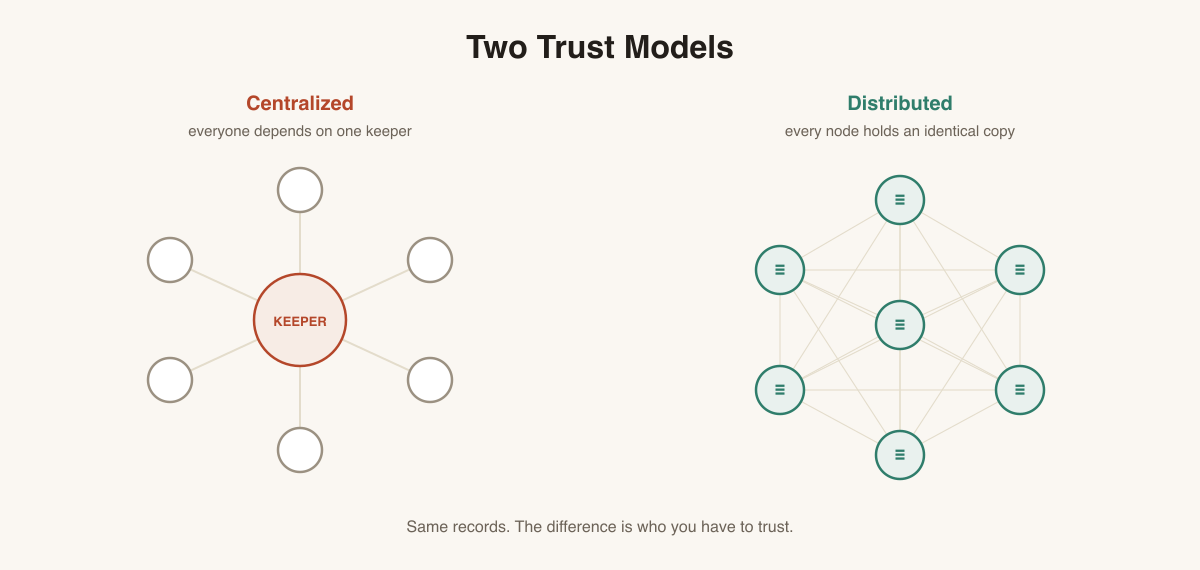 Same records, but moving from one master copy to many changes the trust model entirely.
The difference isn’t the data; it’s who you have to trust.
| Traditional ledger | Blockchain | |
|---|---|---|
| Who holds it | One organization | Everyone, identically |
| Who can edit | The keeper | No one, retroactively |
| Trust model | Trust the institution | Trust the math + the network |
| Point of failure | The central database | No single point |
| Hours | Business hours, batch settlement | 24/7, near-real-time |
| Auditing | Request access, take their word | Anyone can verify directly |
In a traditional system, if the keeper makes an error, hides something, or gets hacked, everyone downstream inherits the problem. A blockchain removes the need to trust any single keeper. You trust the rules and the fact that they’re enforced by a crowd too large to collude. That’s the real innovation: not a better database, but a way to agree on shared facts without a referee.
4. Advantages
- Tamper-evidence. Rewriting history means outrunning the entire network, practically impossible on a large chain. Records are durable and auditable.
- No single point of failure. With copies everywhere, there’s no one server to take down, censor, or corrupt.
- Open verification. Anyone can inspect a public chain and confirm a transaction happened, without asking permission. Auditing shifts from “trust me” to “check for yourself.”
- Programmable rules. Smart contracts (code that runs on the chain) let agreements execute automatically when conditions are met, with no intermediary to hold funds or drag their feet.
- Borderless and always on. Value moves peer-to-peer, around the clock, without waiting on banking hours or correspondent networks.
- Reduced middleman friction. For some workflows, cutting out clearinghouses and reconciliation between parties saves real time and cost.
5. Disadvantages
Blockchain is not magic, and pretending otherwise is how people lose money. The honest limitations:
- Scalability and speed. Making thousands of computers agree is slower than one database doing a write. Public chains handle far fewer transactions per second than a system like Visa, though newer designs and “layer 2” networks are closing the gap.
- Energy cost (for Proof of Work). Bitcoin’s security comes from consuming serious electricity. Proof of Stake largely solves this, but not every chain uses it.
- Immutability cuts both ways. “Can’t be changed” is great, until you send funds to the wrong address or a bug gets deployed. There’s often no undo button and no customer-support line.
- The key-management problem. Lose your private key and you lose your assets, permanently. There’s no “forgot password.” This is a genuine barrier to mainstream use.
- Privacy is subtle. Public chains are pseudonymous, not anonymous. Every transaction is visible forever, and analysis can often link addresses to real identities.
- Complexity and immaturity. The tooling is young, the user experience is rough, and the space attracts scams. Regulation is still catching up in most countries.
- It’s often the wrong tool. If one trusted party can maintain the record just fine, a normal database is cheaper, faster, and simpler. Blockchain earns its overhead only when removing the trusted middleman is the whole point.
That last one matters most: a blockchain is worth its cost only when no single party can be trusted to hold the ledger. Plenty of “blockchain” projects would have been better off as a spreadsheet.
6. Applications: Today and Tomorrow
Some uses are already mainstream; others are promising but still maturing.
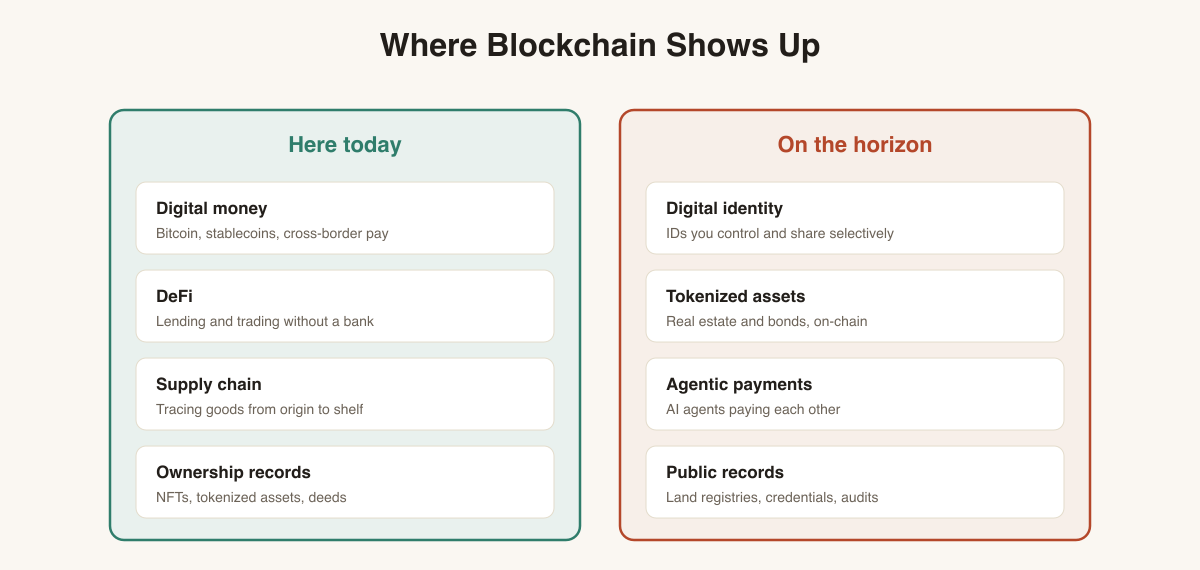 Live and mainstream on the left; real potential still being proven out on the right.
Working today:
- Digital money & payments. Bitcoin as a store of value; stablecoins (tokens pegged to the dollar) increasingly used for fast, cheap cross-border transfers.
- Decentralized finance (DeFi). Lending, borrowing, and trading through smart contracts instead of banks, for better and worse.
- Supply-chain tracing. Following food, pharmaceuticals, and components from origin to shelf, with a shared record every party can trust.
- Ownership & provenance. Tokenized assets and NFTs used as verifiable records of who owns what, from art to event tickets.
On the horizon:
- Self-sovereign identity. Digital IDs you control and present selectively, proving you’re over 18 without handing over your full passport.
- Tokenized real-world assets. Real estate, bonds, and funds represented on-chain, enabling fractional ownership and faster settlement. Major financial institutions are actively piloting this.
- Agentic payments. As AI agents start transacting on our behalf, blockchains offer a natural rail for machines to pay each other autonomously, with programmable limits.
- Public records & governance. Land registries, academic credentials, and audit trails where a transparent, tamper-evident log is genuinely valuable.
The One-Paragraph Takeaway
A blockchain is a shared, append-only ledger that a large network maintains together, using hashes to make tampering obvious and a consensus mechanism to agree on new entries without a central authority. It trades speed and simplicity for something specific and valuable: the ability for people who don’t trust each other to agree on a shared record without a middleman. When that trust gap is real, it’s a genuinely new tool. When it isn’t, a database will do, and knowing the difference is most of what separates the signal from the hype.
Have thoughts on this? I'd genuinely love to hear them. Find me on X or LinkedIn.
A note: The views here are my own and don't represent my employer or anyone I work with. Everything I write is personal opinion, shared for general informational and educational purposes, and reflects my thinking at the time of writing. It is not professional, financial, legal, or investment advice. Please read posts in full rather than pulling lines out of context, and do your own research before acting on anything.